Published
Comments None
Categories |

This week, a look at the new Samsung Galaxy Note8 handset, and Samsung’s Bixby digital assistant gets voice support. Also, a new app that forces message recipients to acknowledge it.

Samsung announced a new Galaxy Note8 mobile it hopes will make you forget last year’s disasters

At a press event in New York earlier this week, Samsung revealed the Galaxy Note8, a new version of the tech company’s phablet (smartphone/tablet).

In the past, what’s really distinguished the Note devices has been the screen size, but that’s no longer the case with the Note8. It’s got a 6.3-inch display with a similar tall and narrow form factor that Samsung introduced with the Galaxy S8 smartphone family. That makes the Note8 just a bit bigger than the Galaxy S8 Plus.

So what makes the Note8 different?

It has 6 GB of RAM, compared to 4 GB for the two S8 models, for one thing. And the Note8 is equipped with a S-Pen stylus that fans of the device love because they can use it to take notes and to draw. It also has two 12 megapixel rear cameras – one with a wide-angle lens and the other with a telephoto lens.

Other non-exclusive features include water and dust resistance and support for wireless charging.

Which brings me around to the battery. The Note8 has a 3,300 mAh battery, where its predecessor, the infamous Note7, had a 3,500 mAh battery.

That battery, you may remember, led to a worldwide recall of the Note7 because it was catching fire and exploding. Samsung has a new battery safety process in place that should prevent a similar design and manufacturing fail from happening again.

The new device, now available for pre-order at the usual places, will come in Midnight Black and Deepsea Blue. Pre-order before September 14 to get a free wireless charger convertible and a 128 GB Samsung microSD card.

Without a contract, the Galaxy Note8, which releases on September 15, is priced at $1,300. That seems very expensive, but it’s only a couple of hundred dollars more than the Galaxy S8 and Galaxy S8 Plus were priced at when they were released six months ago.

Bixby digital assistant brings voice commands to Samsung mobile devices

Samsung’s other announcement this week was that its Bixby digital assistant will now understand you when you talk to it.

It’s the same voice command functionality that already exists with Cortana (Windows), Google Assistant, and Siri (Apple), although Bixby seems to be able to perform tasks that other assistants can’t (Although “Take a selfie,” is something I will never say to any phone ever.)

And you can program your own shorthand phrases for oft-repeated tasks, which is a cool idea. So instead of saying, “Remind me to pick up the kids at 4 o’clock,” you can just say, “Kids” and Bixby will do the rest.

New app makes sure your teen – or anyone else – has received your message

ReplyASAP is a unique idea. It forces people who are receiving a message from the app to interact with it, increasing the likelihood that they have actually processed the message.

It was developed by a dad in the UK who realized that he had no idea if the messages – some important, some not so much – were actually being read by his teenaged son.

Available for Android devices now, and soon for iOS, the app is quite overt. It appears over top of anything else that might be on the smartphone’s screen, and plays an alarm noise even if the phone is on silent.

The person receiving the message has to interact with the app in order to turn off the notifications.

Of course, you still can’t be sure that the recipient has read the message, but if they’ve had to look at the screen to turn everything off, there’s at least a greater chance that they have.

The cost of the app scales based on how many people you want to be able to send messages to. There is no cost to the smartphones that are receiving the messages.

There are bound to be some privacy and usage issues to be worked out as this kind of app becomes more popular – imagine what a stalker would do with this, for example, or a company or employer that doesn’t appreciate employee boundaries – but the core idea is not bad.

Especially if you’re a parent.

Published
Comments None
Categories |

This week, a look at the new range extender from TP-Link, and new research indicates that kids benefit from learning to print and write cursive. But first, it’s time to forget everything you were led to believe about creating strong passwords.

Guy who created all those password rules apologizes, admits they are no good

You can forget all those password rules that have been drilled into your brain.

Mixing up upper and lower case letters, using numbers and symbols and making the arrangement of the characters random is, it turns out, a waste of time.

The guy who came up with those requirements, Bill Burr, told the Wall Street Journal, “Much of what I did I now regret.”

It turns out that those rules made it so difficult for people that most of us have not really followed them, which has made things easier for the hackers.

The new standards eschew mixed-up, random characters for long, easy to remember phrases.

In Burr’s defence, there wasn’t much research on the vulnerability of passwords when he came up with his document back in 2003.

Since then there have been dozens of data breaches and millions of passwords have been leaked, which has provided insight into the passwords that people use.

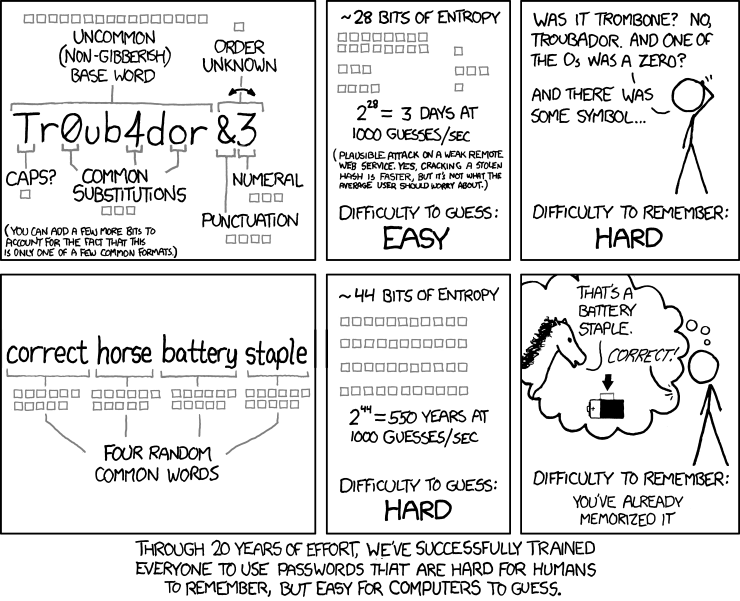
Not to mention the basic math behind it all clearly demonstrates that phrases of words are harder for computers to crack than are passwords made up of mixed up characters.

This idea was captured six years ago by Randall Munroe in his online comic xkcd.com.

All we need to do now is get all the companies out there to change their password rules. How long do you think that’s going to take?

TP-Link top notch range extender boosts wireless networking performance in larger homes

I’ve been using a TP-Link router since last fall. The Archer C3150 supports multiple users and automatically switches to the band that is ideal for the device connecting to it.

My home WiFi has gotten even better in the past couple of weeks because I’ve augmented the C3150 with the TP-Link AC2600 RE650 range extender.

The device plugs into a power outlet a couple of rooms away from my router. The extender actually helped me find the best place to put it with a built-in signal light.

Not only does the RE650 boost the range of my WiFi, but it also give me an ethernet port that I can plug other devices into, which gives a more robust connection that just wireless alone.

And I can select specific devices on my network that I want to prioritize, and the RE650 will send a specific signal to that device with what TP-Link calls “beamforming technology”.

TP-Link home networking devices are great because they perform well and are priced cheaper than those from other manufacturers.

And they are more available because Walmart Canada has started stocking the devices. The AC1900 dual-band gigabit router from the company is only $130 at Walmart, and the RE450 AC1750 range extender, a slightly less powerful device than the RE650 I’ve been using, is $120.

Why kids need to learn handwriting, too

Occupational therapists and child development specialists have found a link between infant crawling and the ability of older children to print and write. It turns out that there’s good reason for kids to continue learning how to communicate with pen(cil) and paper.

Research being conducted in Seattle at the University of Washington, and referenced in the Washington Post and Quartz, indicates that kids communicate faster, using more words and more ideas, when printing or using cursive when compared to keyboarding.

It seems as though writing engages our brains differently and is related to better information retention.

Not to mention being able to sign a legal document.

Published
Comments None
Categories |

On Friday, Charles and I talked about Lego’s new Boost building kit, which combines building, playing, and coding all in one fun experience. Plus, the Cozmo robot is not only programmable, but has AI to help it learn as it goes. And then there’s the upcoming solar eclipse.

Unfortunately, this episode wasn’t podcast. If the audio shows up at any point, I’ll post it.

Published
Comments None
Categories |

This week, all you need to know about the upcoming solar eclipse. But first, a look at Lego’s new Boost building kit and the Cozmo robot companion.

Lego Boost is a great way to help kids have fun building while learning some basic coding

Last week I wrote about a new product, Lego Boost.

It’s a building kit that comes with 847 bricks that can be turned into one of five pre-designed models, which can then be programmed to interact with the builder and its environment.

Developed for 7 to 12 year olds, it’s a great, fun way for anyone to learn the basics of programming, which I believe is an essential skill for the future.

Cozmo is a programmable robot with personality

If your kids are into robots, check out Cozmo. It’s a small device that looks kind of like a bulldozer, but it’s designed with sophisticated artificial intelligence, so it can learn the environment to better navigate. Cozmo even learns to recognize familiar people.

Equipped with a screen to communicate, Cozmo has about a thousand animations that it can use to respond, to you and to situations it confronts. It is through these reactions, and the corresponding vocal responses, that Cozmo is able to show its personality. It it really does have a personality.

The robot comes from Anki, a company started by three graduates from Carnegie Melon’s Robotics Institute. While Cozmo can operate on its own, you can also control it. You can explore the world through it, using a tablet to operate it and see what it sees. And you can also program it with Code Lab, which is based on the Scratch coding language develped at the MIT Media Lab, which uses simple blocks to enable powerful programming.

Cozmo is priced at CAN$250 and is available in Canada exclusively at Best Buy.

A solar eclipse is happening soon and here’s how you can watch it, safely

I’m going to start with a reminder: Never look directly at the sun. Your eyes may not hurt if there’s no glare, but the radiation you can’t detect could be cooking your retinas. Learn more about eclipse safety from NASA.

Having said that, with proper equipment you can witness the solar eclipse that will happen on Monday, August 21.

There’s a list of approved manufacturers of eclipse viewing products curated by the American Astronomical Society. And your local science centres and museums will have certified products on shelves.

But be wary of anything sold online, particularly at Amazon, where there is no way to verify if the glasses you’re getting actually meet the international standards.

The path of totality of the eclipse cuts across the middle of the United States, including northern Oregon. I know a bunch of people from the Vancouver area who are traveling to Salem, Oregon to witness the event.

In the Lower Mainland of B.C., 90 percent of the sun will be blocked by the moon. Calgary will be about 80 percent, Winnipeg about 75, and Edmonton closer to 70.

The video below shows the path of the shadow, and is from NASA.

The eclipse becomes visible at just after 9 a.m. Pacific time. The totality hits the Pacific coastline at about 10:16 and passes over the Atlantic coast at South Carolina at about 2:50 p.m. Eastern. Total time is about two and a half hours.

Astronomy clubs and science organizations everywhere will be doing something on eclipse day. Here are some free events taking place in the major cities in western Canada. A full list has been compiled by the Royal Astronomical Society of Canada.

Victoria

Vancouver

Edmonton

Calgary

Regina

Saskatoon

Winnipeg

Keep in mind that if it’s a cloudy day and you wouldn’t normally see the sun, you won’t be able to see the eclipse.

← Older Newer →